Japanese Art T-Shirt Ideas, From the Great Wave to Koi
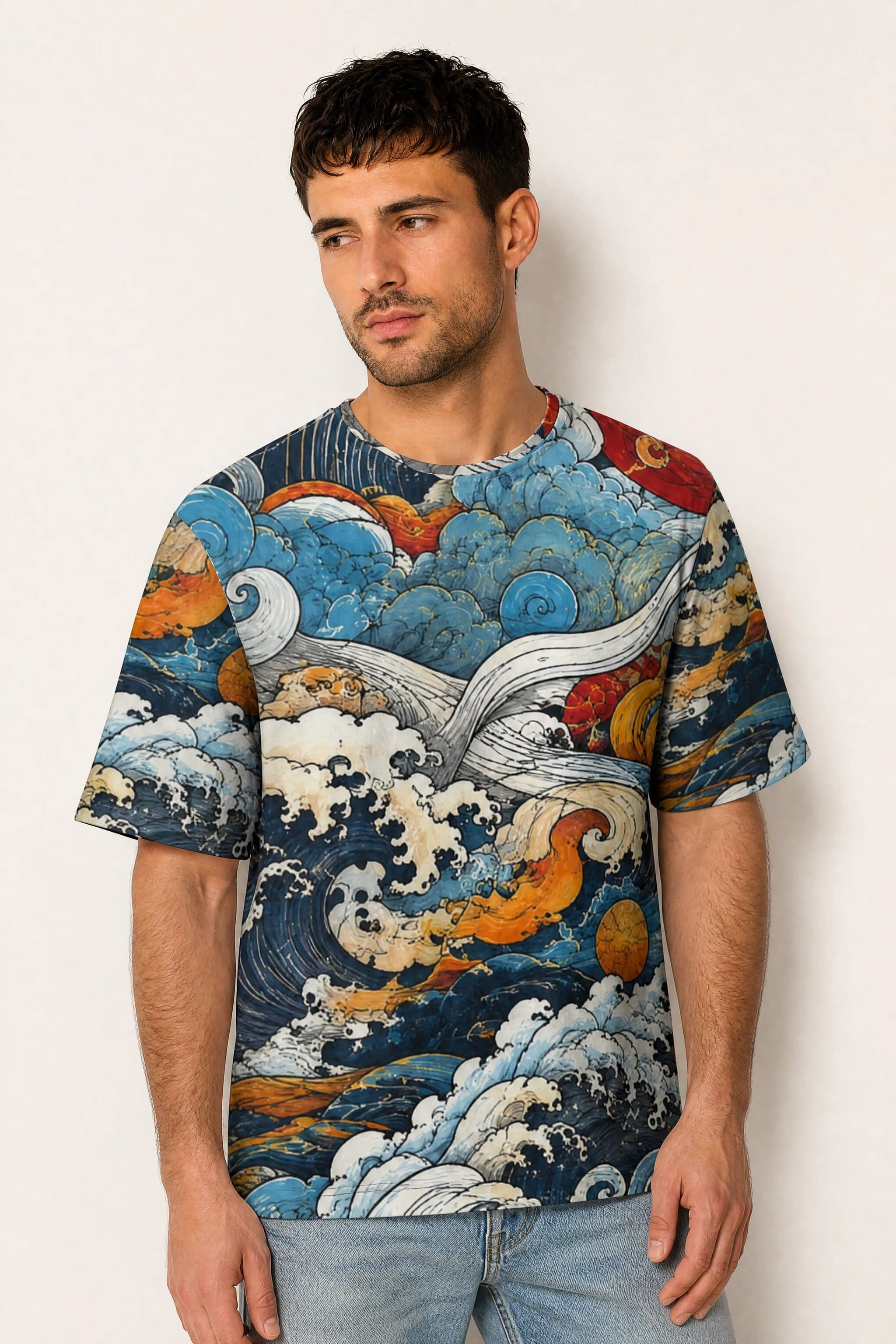
A Japanese art t-shirt — you will also see it as a wave shirt, a koi fish shirt, an ukiyo-e tee, a Japanese art shirt for men — carries a style that solved the whole-canvas problem two centuries before the whole-canvas tee existed. The woodblock artists filled every corner of the sheet the way a print fills every corner of a shirt. Both masters and their rules live in the store today.
The short answer
Japanese art survives the crop better than almost any other tradition, because ukiyo-e was engineered for printing: flat color planes, bold outlines filled with black keylines, no single focal point sitting in the middle. And the provenance question answers itself — the great Hokusai and Hiroshige sheets are public domain, centuries past any rights holder, so the only remaining question is the cloth: printed in reactive dye on 100% cotton, their thin black lines hold.
Koi, wave, rain: Japanese art t-shirt designs to look for
The wearable masters set carries the originals, ready to wear:
- The Great Wave off Kanagawa — Hokusai’s woodblock from the early 1830s. The wave’s crest and the spray curl across the torso and wrap over the seams; a crop anywhere leaves wave somewhere.
- Sudden Shower over Shin-Ohashi Bridge — Hiroshige’s 1857 print. Vertical rain lines become pure texture: the pattern keeps raining across panels and sleeves no matter where the shirt cuts it.
- Carp Swimming by Water Weeds — the carp-and-waterweeds print attributed to Hokusai. One koi loops through the sheet; on a shirt it reads as the koi fish shirt you searched for, swimming wherever the fabric folds.
Two designs in the current catalog stay in the same spirit: Japanese Waves Sky, indigo and ochre curls running down both sleeves, and the Vintage Koi Fish All Over Print with its faded fish-and-water field. The trade, in one list:
Choose the wave if you want one image the whole world already reads as Japanese.
Choose the koi carp if you want a subject and a surface at once.
Choose the rain if texture over story is your idea of a shirt.
Why a woodblock survives the seams
Ukiyo-e was printed in multiples — a popular, reproducible art — so its language never depended on a centered frame: the composition runs edge to edge, color areas sit flat against each other, and outlines were drawn knowing the paper would be printed and trimmed anywhere. On our cloth the logic matches: the artwork is printed on the fabric before the shirt is cut and sewn, so a wave continues across a seam — it does not align perfectly, but wave lines are not a portrait and survive the cut. The art t-shirt ideas post calls this kind of pattern field art; Japanese art is the oldest field art there is.
The dye side suits detail: reactive dye bonds with the cellulose inside 100% cotton fibers, so nothing sits on top to crack or peel, and hairline keylines that a plastic layer would blur stay thread-sharp wash after wash.
Provenance: who owns the right wave
Public domain means nobody holds the rights: the artists died centuries ago and their prints are free to publish, which is why the masters set can put the wave next to Van Gogh’s Wheat Field with Cypresses or William Morris’s Strawberry Thief — all out of copyright, all fair to wear. What does not translate is anything under a living rights holder: the intellectual property rules reject brand marks, real people’s faces and characters from licensed series, and in July 2026 a single title carrying a brand name pulled the whole catalog out of Google Shopping until it was cleaned — the strictness is practical, not fussy.
Want your own wave in this company? Draw it: you keep the copyright on everything you upload to the studio, we print it and pay 10% on every paid order for as long as it sells — no template, no vector prep, one photo front, one back, and the layout is built for you.
FAQ
Is the Great Wave off Kanagawa still copyrighted?
No. It was printed in the early 1830s and the author, Hokusai, died in 1849; the print is public domain, and the store’s masters set prints it on cotton.
Did Van Gogh really copy a Hiroshige rain print?
Yes. He painted an oil copy of Hiroshige’s Sudden Shower over Shin-Ohashi Bridge in 1887 — the documented bridge by which Japanese printmaking entered western painting, and that is exactly why the masters collection keeps the two styles side by side.
Can I upload my own Japanese-style wave or koi design?
Yes. In the studio you upload one photo as the front and one as the back, keep the copyright and earn 10% on every sale; designs are printed edge to edge on 100% cotton, made to order.
The bottom line
Japanese art on a t-shirt works because the rules the woodblocks invented are the rules a whole print needs: flat color, lines that cross seams, composition with no center to lose. The masters are public domain, the cloth is reactive-dye cotton, and the wave, the carp and the rain in the all-over print t-shirts collection show how it looks on the body — the sheets were trimmed to survive any crop, and they still do.