Art T-Shirt Ideas That Survive Every Crop
Art t-shirt ideas — t-shirt design ideas, shirt art, designs for a full-print tee — change their rules here. A small chest print is judged by one square; a whole-shirt design is judged everywhere at once: sleeves, back, hem. Below: which art holds up, and how to put your own on the fabric.
The short answer
Ask one question of every idea: how does it look when the shirt cuts it anywhere — shoulder, side seam, hem? Field art (washes, ink splatter, doodles, marble, tie-dye) survives any crop because it is background; a single subject survives only through repetition or one confident statement. allover.art prints the artwork on the cloth before the shirt is cut and sewn, so your design keeps running across seams and down sleeves — choose art that is happy there.
Art t-shirt ideas that become texture
The most forgiving direction is a field: art with no single focal point, the surface itself the picture.
Watercolor washes. Soft-edged color flowing into itself, like Cosmic Abstract Waves — navy and ochre with scattered white dots. A wash has no top or bottom, so no crop puts it the wrong way.
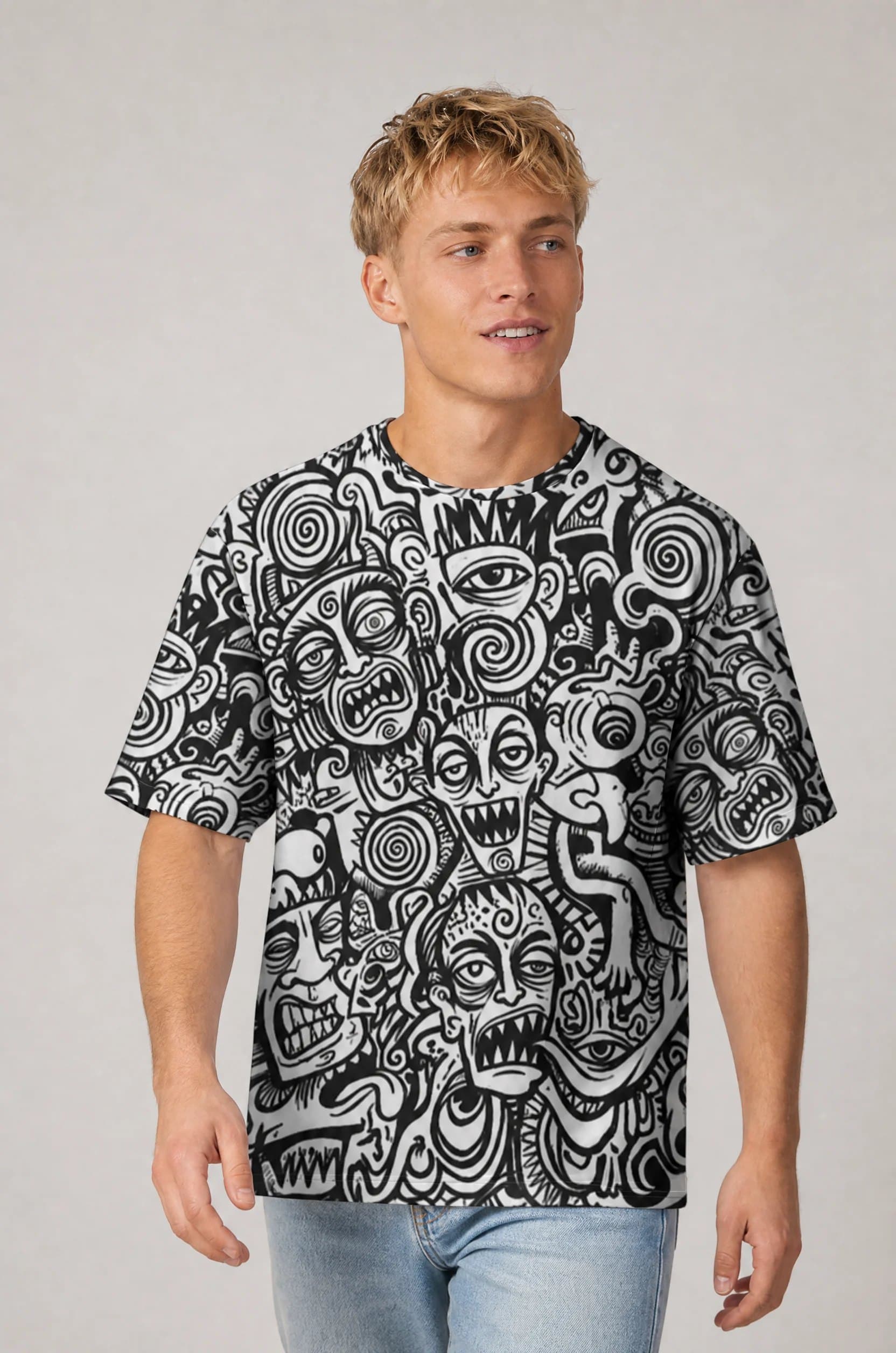
Ink splatter and doodles. A dense field of marks holds up everywhere. Doodle Art Chaos covers a dark ground with spiral eyes, faces, teeth and skulls — no right-side-up, and it reads at any distance.
Marble and geometry. The Blue, Emerald and Fiery Marble Swirl designs borrow stone's composition — swirls with variation everywhere and no subject at all. Tie-dye and geometric patterns work the same way, repeating to the edge of the cut. The poured-marble side has its own walkthrough: our abstract marble t-shirt piece covers the liquid swirl fields and the thin veins that make them. The checklist for building such a field is in composition for the full canvas.
Check the base: shirts here print with reactive dye on 100% cotton, the dye bonding with the cellulose inside the fiber — washes stay breathable, thin lines stay thread-sharp, and no plastic layer sits on top to crack or peel.
Subject art: repetition, or one statement
A single subject is a portrait, and on a whole shirt it has two workable futures.
Repetition. Dozens of small copies turn the subject into texture: cats in different poses, mushrooms marching across the chest, watermelon slices. Camo Cat Crowd does it with felines over a camouflage ground, Whimsical Space Doodles with doodled planets — and repeats survive wherever the next seam falls.
One statement. A single oversized motif fills the front while sleeves and back stay part of the same canvas — the giant cat faces of Curious Kitty and Wide Eyed Feline read from across the room, and the animal-face t-shirts collection keeps that family in one place. The single-statement rule travels to borrowed traditions as well — a woodblock print, a family crest — and the japanese art t-shirt guide covers what the site stocks in that family.
Want the art in one spot instead? That is the placement print vs all-over print choice — a badge on a plain shirt, gone where a seam cuts it. The trade, in one list:
Choose field art if the shirt itself should be the outfit.
Choose repeated subjects if one character in many moods is your story.
Choose one statement if a single look should carry the message.
And once the pick is made, the wearing matters: a whole-canvas design usually rides on a loose cut, so the moves for wearing one well are in how to style an oversized t-shirt.
Your own art on the shirt
Your own idea needs no template either. In the studio, upload one photo as the front and one as the back, and the layout is built for you — no files to prepare, no vector anything. A kid's crayon marathon, a photo of the sky, a line of your own lettering — all of it prints on the same 100% cotton as every design here. The studio walkthrough names the rule that matters: on a chest print, a photograph becomes a rectangle stuck to a shirt — over the whole garment, it becomes the fabric. And when the art is ready for more than one shirt, designers upload theirs and earn royalties when it sells.
What to check before you commit
Sleeve photos. If the pattern runs past the shoulder seam and down the arm, the art was on the cloth before cutting; plain sleeves mean a framed picture in the middle of the shirt.
Seams. Where a design crosses a seam it continues — but it will not align perfectly. The pattern flows; it does not mirror across a sewn edge.
Whites and neon. The dye cannot make white: the white in any design is the undyed shirt, so a design leaning on white ink over a dark ground does not translate one to one — and true neon is out of reach for any dye on cotton. Judge designs by their darks and midtones.
Timing. Shirts are made to order, 2–7 business days to print, with that time already inside the total wait: 12–27 days for the US and Canada, 6–19 for the UK and EU, 9–21 elsewhere; shipping is $10, free from $65.
FAQ
What art works best for an all-over print t-shirt?
Field art with no single focal point — washes, splatter, doodles, marble, tie-dye — plus subjects repeated across the garment; both survive whatever crop the shirt makes.
How do I keep a design from working only in the mock-up?
Follow the shirt, not the rectangle: the torso wrapped, the shoulder seam crossed, the sleeve filled. Variation keeps every panel interesting.
Can I print my own drawing across the whole shirt?
Yes — in the studio: one photo as the front, one as the back, the layout built for you, printed in reactive dye on 100% cotton, made to order.
The bottom line
Art for t-shirts stops being a gamble once you test it against the crop: a field becomes the fabric, a repeat its texture, a single statement the whole stage. Choose for the body you will wear, check the sleeves in the listing, and let the shirt be the frame no rectangle could hold.