
The Abstract Marble T-Shirt: A Whole-Surface Swirl, Not a Sticker
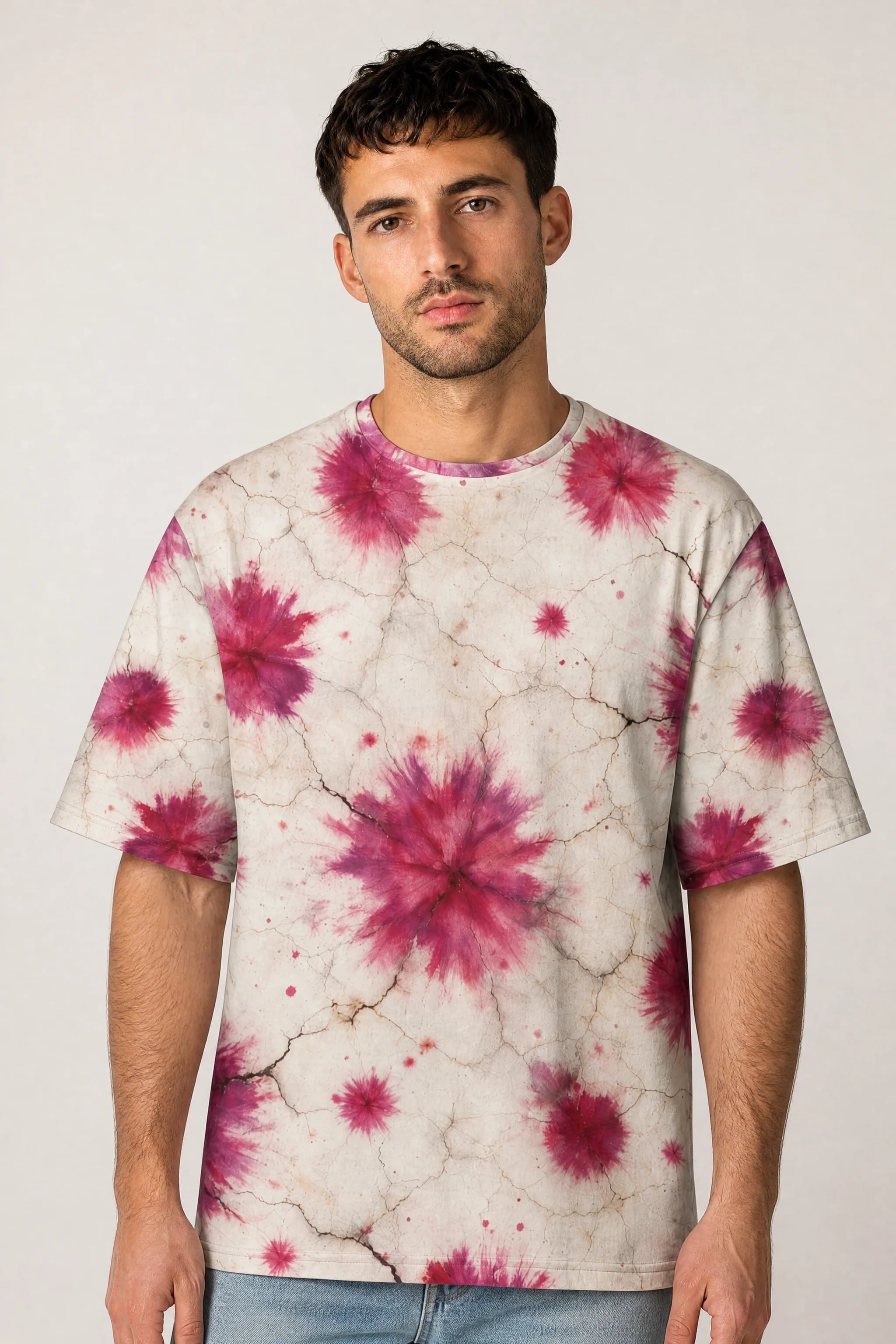
An abstract marble t-shirt arrives under many names: a marble print shirt, a marble swirl tee, a marble texture shirt, fluid art, an acrylic pour. Whatever the name, the artwork is stone logic — liquid color frozen mid-flow, veins and soft washes instead of figures. That one quality decides where a marble shirt gets printed, before anything else about style.
The short answer
A marble print belongs on an all-over shirt because it has no edges: no repeated block to wrap, no figure to crop — a field of flow that can continue across seams without ending anywhere. On 100% cotton, printed with reactive dye before the fabric is cut, the swirl sits in the fiber: soft color fields keep their depth wash after wash, and the fine pale veins stay sharp instead of riding on the cloth like plastic.
Why marble dies as a badge
Put a marble artwork in a small square on a plain blank and the texture argument collapses. A pour painting is designed to have no frame; the moment a rectangle cuts it off, the shirt reads as a photo mounted on a chest — a badge that stops at its own border. Our placement-vs-all-over guide shows the same distinction on other artwork, but marble is where it hurts most, because texture is exactly what a rectangle interrupts.
The fix is mechanical. On an all-over shirt the fabric is covered edge to edge before the shirt is cut and sewn, so the swirl starts before the shoulder and runs past the hem — the panels were a single sheet first. One honest detail: where front meets back at a seam, the flow continues but the veins do not line up perfectly. That is the texture of a sewn garment, which is one more reason the swirl reads as fabric rather than sticker.
The anatomy of an abstract marble t-shirt
The abstract collection gathers the family in one place, and three textures are worth telling apart:
- Liquid pour swirls. Fluid movement with thin vein lines, the look of paint poured and guided across a surface. Loud; wants the basic tee, where the pattern is the outfit.
- Veined mineral texture. Magenta Marble Bloom runs the pink-to-violet stone look sleeve to hem — on the women's long sleeve the swirl holds all the way through the cuffs.
- Soft marble washes. Golden Marble Leaves moves the same pour logic into warm, faded tones. Quieter; it pairs with denim without shouting.
Both designs are stocked on men's and women's basic, oversized and long sleeve cuts. If you are torn: choose the pour if you want the pattern to be the outfit; choose the washes if denim is the outfit and the shirt is the accent. Which art styles survive a whole-shirt crop at all is sorted in our art t-shirt ideas roundup.
For the arm-length version of the same family, abstract long sleeve t-shirts is the companion piece.
The fiber decides whether the swirl keeps its depth
Marble art lives and dies by two things: wide soft color fields and hair-thin veins. Both are where the printing process shows its character. Reactive dye bonds with the cellulose inside 100% cotton fiber, so color becomes part of the thread — the soft fields keep their depth through washing because there is no surface layer to abrade, the delicate vein lines stay sharp because no film blurs them, and the shirt still breathes like a cotton shirt.
Most printed marble shirts sold online are sublimation on polyester: the dye does bond inside that synthetic fiber, so nothing cracks — but the fabric is the compromise. Rarer are pigment all-over prints on cotton, where ink sits on the surface: seams and creases show white lines, and the surface cracks with washing — that is what our why-prints-crack guide explains print by print.
Two honest limits travel with every marble shirt we sell: there is no white dye, so the white in a marble design is the undyed cotton itself and light-on-dark cannot work the way a white underbase would; and true neon is out of reach for any dye that bonds to cotton, which is why a stone palette reads as stone — never as a glow stick.
FAQ
Is a marble shirt the same as tie-dye?
No. Tie-dye gets its bands and circles by folding and binding real cloth; marble art is poured to imitate stone. Both are field patterns that survive a full-shirt print — and both suit a buyer who does not want a framed picture on a chest.
Will a marble print crack or peel off a cotton shirt?
Not where the dye is reactive: it bonds inside the cotton fiber, and every garment is washed hot in production before it is sewn, so the print is wash-proven before it reaches you. Cracking and peeling belong to inks that sit on top of the fabric — not to color that became the thread.
Can a marble design be light-on-dark?
Not with this chemistry. There is no white dye, so the white you see on any cotton all-over shirt is undyed cotton — dark-ground marbles lean on cream and natural tones.
The bottom line
A marble t-shirt is the one art family that argues for the whole shirt by construction: a texture with no border loses nothing to a full-coverage print and everything to a framed patch on a blank. Keep the fiber honest — 100% cotton with dye in it, not ink on it — and the swirl keeps its depth as long as the shirt does.