
The only thing we keep in stock is cloth
Every print-on-demand company will tell you nothing is made until you order it. Almost none of them mean it.
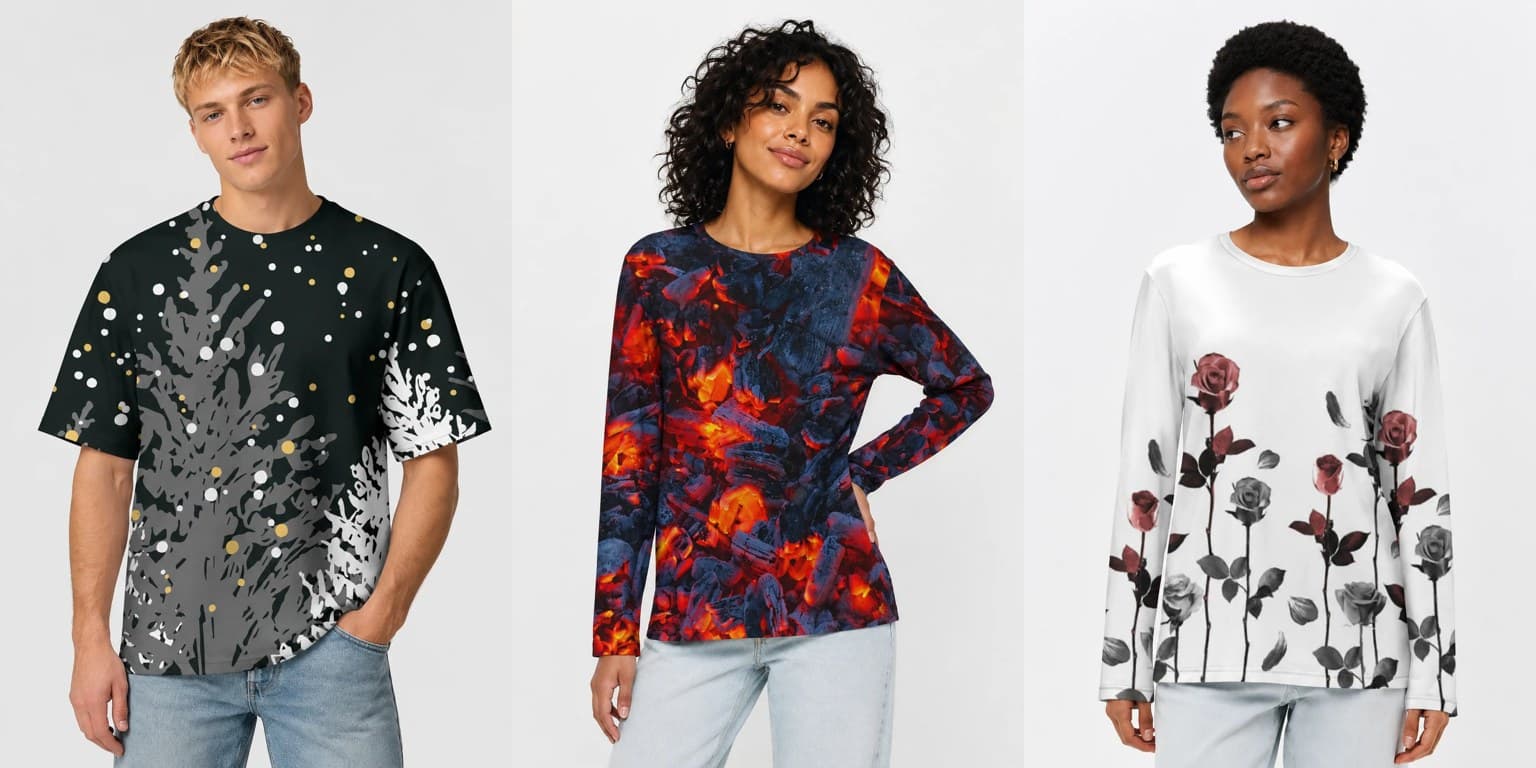
Two kinds of inventory. On the left, blanks: sizes and colors that can run out, and that quietly change when the supplier does. On the right, what we keep instead.
Here is what actually happens at a normal print-on-demand supplier. Somewhere there is a warehouse full of blank t-shirts. Black ones, white ones, heather gray ones, in sizes S through 3XL, from whichever manufacturer had the best price this year. When your order comes in, a person picks the right blank off a shelf and runs it through a printer. The printing is on demand. The shirt is not. The shirt has been sitting in a box for months.
That warehouse is the whole problem, and it leaks into your order in three ways.
Things run out
Black in size S goes. Or the oversized 3XL, which never gets ordered in the same quantities and is always the first gap. You find the design you want, choose your size, and the site tells you it is unavailable — not because anything is wrong with the design, but because a box in a warehouse is empty.
The blank changes underneath you
Suppliers get discontinued. Prices move. A color is dropped from the range. So the seller switches to a different blank, and the shirt quietly becomes a different shirt: different cut, different weight of cotton, different collar. The listing photo stays the same. Your second order does not match your first.
Anyone who has ordered from the big print-on-demand marketplaces more than once knows this feeling. Same shop, same size, and yet a different garment arrives. It is a lottery, and nobody tells you that you are playing.
The print has to fit the blank
The blank is already sewn, so the printer can only reach the flat part of it. That is why almost every print-on-demand shirt has a rectangle on the chest with empty fabric around it. Not an aesthetic choice — a consequence of the warehouse.
What we keep in stock
Cloth. Rolls of undyed cotton, a few weights, all white. That is the entire inventory.
There is no shelf of blank shirts here, because we do not sew a shirt until an order exists. We print the fabric first, then cut the panels from that printed fabric, then sew the garment. The shirt comes into being for you, out of cloth that had no size and no color until your order gave it one.
The consequences run in the opposite direction to everything above.
Nothing can be out of stock. Not a size, not a color, not a combination. There is no box to be empty. If you want an oversized 3XL in a design nobody has ordered before, you will get it, because it is made the same way as everything else — from cloth.
The cut does not drift. Our patterns are files, not a supplier's catalog. The base tee cut today is the same base tee cut in six months, because it is the same pattern file. Order twice, get the same garment twice.
The print is not confined to a rectangle. Because the fabric is printed before it becomes a shirt, the design runs to the seams, onto the sleeves, over the shoulders. The warehouse constraint simply is not there to work around.
The part that sounds backwards
Our process is heavier than classic print-on-demand. More stages, more machines, more things to get right — printing, steaming, washing, drying, cutting, sewing, checking. It takes longer and costs more to run.
And yet it is the purer version of on-demand. In the classic model only the last step happens after your order; everything before it happened months earlier, in bulk, on a guess about what people would want. In ours, the guess is limited to how much white cloth to buy. Everything that makes the garment yours — the print, the size, the cut — happens after you ask for it.
The more complicated way turns out to be the more honest one.
What we are limited by
It would be a poor argument if we claimed no limits at all, so here are ours, plainly.
We print with reactive dye on cotton, so we cannot do neon or fluorescent — those need pigments that sit on top of synthetic fabric, which is the thing we deliberately do not do. Cutting real fabric shifts by about 2% at the seams, so a pattern that depends on pixel-perfect alignment across a seam will not survive. And because your shirt does not exist yet, you wait for it: production takes days, not minutes.
Those are physical limits. They come from cotton and dye and scissors. They are not warehouse limits, and no amount of stock management would remove them — or introduce them.
That is the difference we would rather be judged on.
Related: why made to order takes weeks · DTG versus all-over reactive · cotton or polyester