Space T-Shirts: Why a Nebula Needs the Whole Shirt
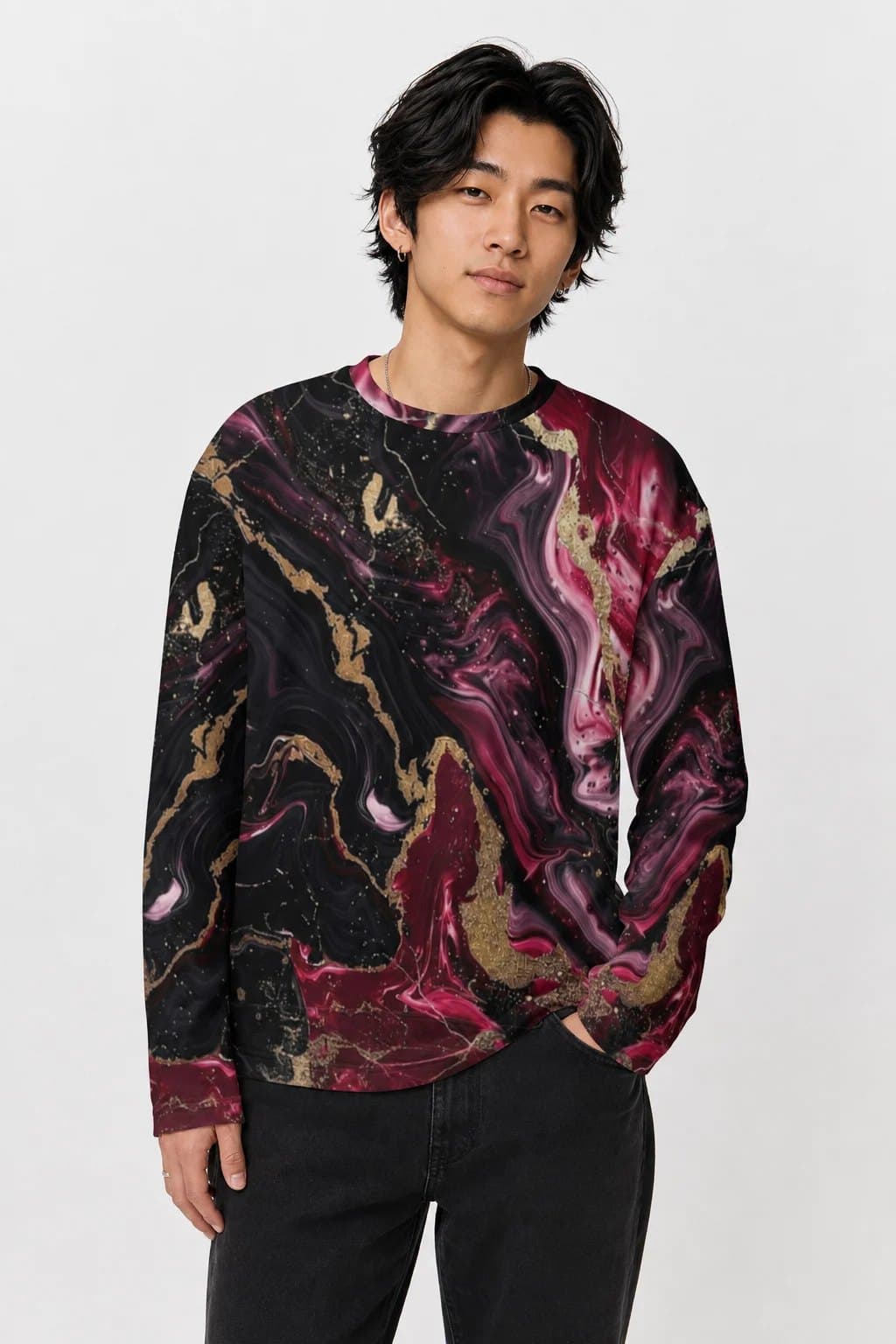
A space t-shirt — you will also see it as a galaxy tee, a cosmic or nebula print, a starfield shirt — is the one design theme where the background IS the subject. Nothing to place on the chest, and the rule that works for almost every other graphic fails here. Here is why the sky wants your whole shirt.
The short answer
A nebula is a field, not a focal point. Printed inside a rectangle on a plain shirt, it becomes a framed photograph of the sky — the frame does the work the sky itself does. Printed edge to edge before the shirt is cut and sewn, the field keeps running past the shoulder seams and down the sleeves, and the garment starts doing what the night sky does: surround. On 100% cotton that field stays cloth, and the white in the design is the shirt itself showing through.
A picture of space is not space
Almost every other graphic is a subject — a face, a mark, a message — and subjects want a placement print: one focal rectangle on a finished blank, margins around it. Space designs that ARE subjects, like an astronaut helmet or a planet portrait, follow exactly how placement and all-over print differ.
Space breaks the rule only where the design stays a background. A nebula has no orientation and no natural stopping edge: it shades into darkness at every side it can find. Put it in a rectangle and the rectangle announces itself as a frame, and the eye reads margins, not depth. Run the field off the garment edge and the wearer stops looking at a picture of the sky and stands inside it.
There is a second family: space doodles. Whimsical Space Doodles, Cute Solar System Art or Need More Space Cats repeat hundreds of tiny subjects — rockets, rings, planets, cats — with no single hero; many small subjects spread over a garment read as a field of small subjects, which is what the night sky is.
The sky on 100% cotton
A field this large is only worth having if it still feels like cloth. Every allover.art shirt prints with reactive dye on 100% cotton: the dye bonds with the cellulose inside the fiber, so a chest-to-sleeve nebula is thread, not a film sitting on top — the fabric keeps its softness and breathability, and nothing sits on it to crack or peel.
The whites carry the theme further. There is no white dye, so where a space design wants pure white, those areas are undyed cotton showing through — the shirt's own surface becomes the stars between the clouds of color. And because the fabric is printed before the shirt is cut and sewn, the field continues across the seams; where panels meet, the pattern continues but does not align perfectly — the nature of printing on cloth.
The glow has a ceiling. A dye that bonds to cotton cannot reach true neon or fluorescent color, so a printed galaxy reads luminous rather than radioactive — the brightest reactive dye gets lives in the neon collection. Where the sky really does go radioactive is on synthetics, not cotton — sublimation on polyester — and the trade-offs are listed in the cotton vs polyester comparison if you want both sides.
Space t-shirts: what to check in the listing
Coverage. The sleeve photos settle it. If the field runs past the shoulder seam and down the arm, the shirt was printed before it was cut; if the sleeves are plain, you are buying a framed picture of the sky — worth deciding whether that is what you meant.
Field or subject. Painterly nebulae and starfields — Watercolor Galaxy Nebula, Purple Nebula Starfield, Cosmic Nebula Dreamscape, Crimson Nebulae — are made to fill a garment edge to edge, as do the doodle families above. Both sides sit together in the space collection and the galaxy collection.
The cut. Large painterly fields want room: our oversized cut is roughly 8 cm wider across the chest and 7–9 cm longer than the basic one, so the dark areas spread instead of bunching, and long sleeves carry the field down the arm. Kids get the same prints, sized by height.
Choose the field if the shirt itself should be the sky and the outfit can quiet down around it. Choose a subject design if the rocket or the planet is the message and a placement frame suits it. Both are legitimate; only one of them surrounds.
FAQ
Do galaxy prints hold up on 100% cotton?
They hold well, because reactive dye bonds inside the fiber: the color is part of the thread, so the shirt breathes like cotton and the print has no plastic layer to crack or peel. Wash the cotton, not the print.
What is the difference between a nebula shirt and a space print on the chest?
Coverage. A nebula shirt means the field extends across the whole garment, seams and sleeves included; a chest print is one rectangle of sky on a blank. Sleeve photos tell you which one you are buying.
Why do the galaxy colors stop short of the photos' glow?
Because dye on cotton has a ceiling: it cannot produce true neon or fluorescent color, and no white dye means whites come from the undyed cotton. On synthetics, sublimation reaches further — the comparison above lists the trade-offs.
The bottom line
Space is the one subject that works better without a frame: check the sleeves for the field running off the edge, give the dark areas room in the oversized cut, and let the shirt be the one loud thing you wear. The stars it wants white are the shirt being itself.