
Psychedelic T-Shirts: Loud Print, Not a Poster
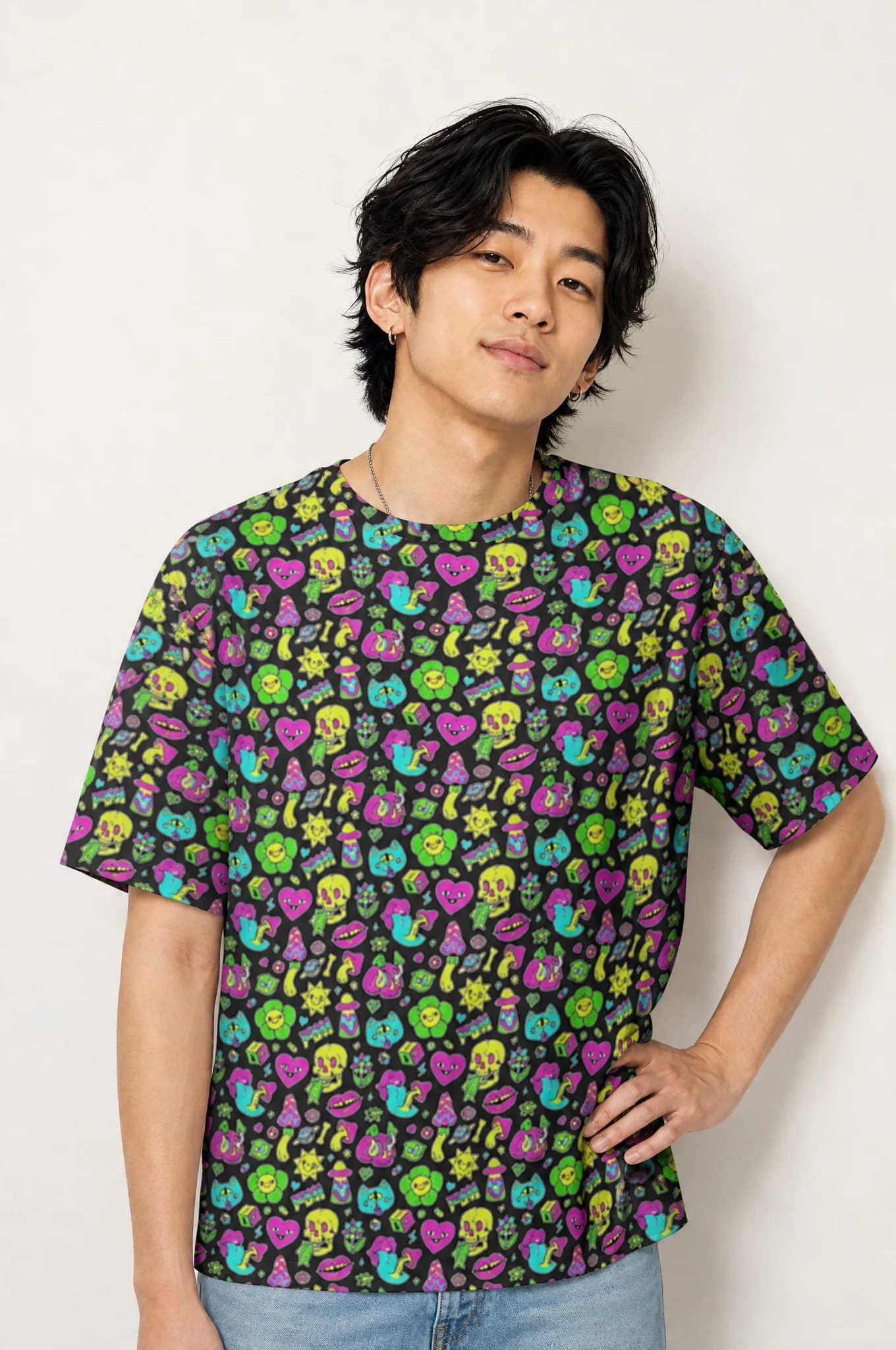
A psychedelic t-shirt — the same thing shoppers call a trippy tee, a loud printed shirt or a full-coverage graphic tee — is the point where clothing stops being a background layer. The usual worry is not the price or the fabric. It is looking like you are wearing a poster. Here is where that look actually comes from, and how to wear the loudest prints so they read as clothes.
The short answer
The poster look does not come from loud color. It comes from a border: a loud picture inside a hard rectangle on an otherwise plain shirt reads as wall art, while the same loudness printed edge to edge before the shirt is cut and sewn reads as fabric. So the first check is not the color — it is the sleeve photos — and the only styling rule that follows is that the shirt is already the outfit's loud item.
Where the poster look really comes from
A poster is built to be framed: one focal point, margins around it, a hard rectangular edge. Set that picture on the chest of a blank shirt and you get the merch silhouette it was made for — a placement print. Plenty of loud psychedelic graphics get sold exactly that way — those end up looking like signage.
The same loudness stops looking like a poster when there is no frame. Liquid pours, fractal spirals and repeating doodle fields have no focal center and no margins; they tile. On allover.art the fabric is printed edge to edge on the roll before the shirt is cut and sewn, so Psychedelic Mushroom All Over Print — doodle flowers, skulls and mushrooms in lime, magenta and cyan on black — keeps going past the shoulder seam and down the sleeve, and Vibrant Fluid Art Swirls pours across the seams without stopping anywhere. The eye reads that like it reads any patterned clothing, not a sign. That is the real difference between a placement print and an all-over print, and it matters most on the loudest designs — our placement vs all-over guide shows it on the seams. Galaxies are the same bet — bright scatter with no border, a field rather than a framed picture — and the space galaxy t-shirts guide covers that family.
Why loud color survives on cotton
Full-coverage loudness has to live in the cloth, or it starts competing with it. Every allover.art shirt is reactive-dyed 100% cotton: the dye bonds with the cellulose inside the fiber, so the color is thread, not a film sitting on top. That is why a fully printed shirt still breathes and keeps the softness of cotton instead of gaining the sheen of a plastic layer — and why the color cannot crack or peel.
One honest limit: a dye that bonds to cotton cannot produce true neon or fluorescent color, and white is the other limit — there is no white dye, so white in these designs is the undyed cotton showing through.
The neon collection is the brightest reactive dye gets. A real neon glow lives instead on the other side of that chemistry; what changes when the dye moves to synthetics — sublimation on polyester — is listed in the cotton vs polyester comparison.
How to wear psychedelic graphic tees
Coverage carries the loudness, so styling carries restraint:
- Choose one loud item per outfit. The shirt is it; keep pants, shorts and outer layers quiet — denim, khaki, black.
- Match pattern to cut. Big pours and dense doodle fields want room: our oversized cut is roughly 8 cm wider across the chest and 7–9 cm longer than the basic one, so a large repeat breathes instead of bunching; finer repeats sit fine in the basic cut.
- Go long sleeve in cold weather for more pattern, not more noise — the sleeves just extend the artwork.
Then stop adding — a second loud item is where prints turn into collage.
Psychedelic t-shirts: what to check before you buy
Coverage. Sleeve photos settle it — if the pattern runs past the shoulder seam, it is printed before cut and sew; if the sleeves are plain, the loud part is a rectangle on the chest.
The subject test. Ask what the design is: one focal picture (a single face, a logo-like mark) needs a border, so it was made for a placement; a repeated or flowing pattern with no center can cover a garment.
The fabric. 100% cotton with reactive dye keeps the hand of the cloth; the sublimation route also covers fully, but the cloth is different — the comparison above lists what to feel for.
Choose the full-coverage pattern if the shirt itself is the statement and you want the whole garment involved. Choose a placement print if the picture is the message and plain sleeves are fine. Both are legitimate — only one of them looks like clothing when it gets loud.
FAQ
Do loud psychedelic prints work on 100% cotton?
Yes. Reactive dye bonds inside the cotton fiber, so a full-coverage pattern keeps the fabric's softness and breathability, with no plastic layer to crack or peel — the color is thread, not a coating.
How do I wear a psychedelic t-shirt without overdoing it?
Keep it the only loud item: quiet bottoms, calm shoes, no competing prints. Coverage makes the shirt loud enough that everything else can step back.
Do the bright colors survive washing?
They are part of the fiber, not a coating — the fabric is washed hot as part of production, before the shirt is sewn. The care rules in our wash guide are about the cotton itself, not about protecting the print.
The bottom line
Wear the loudness as fabric, not as a framed picture: check the sleeves for coverage, pick the cut that gives the pattern room, and keep the rest quiet. The psychedelic collection gathers those patterns in one place.