
Full Print T-Shirt: What All-Over, AOP, Edge-to-Edge and Sublimated Actually Mean
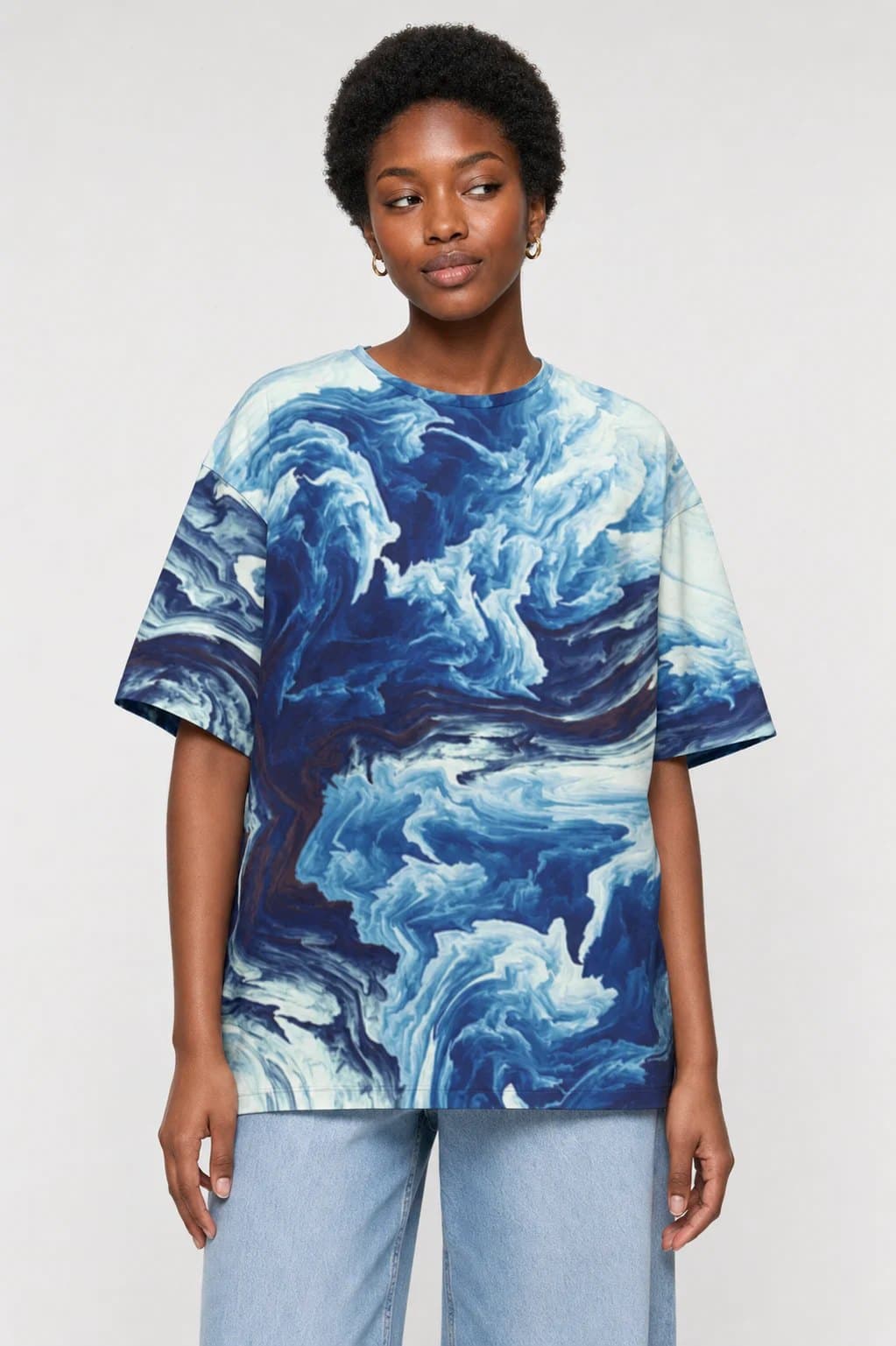
A full print t-shirt — listed as an all-over print, an AOP shirt, an edge-to-edge print, or sometimes just an all over shirt — is a shirt where the design covers the entire garment instead of sitting in a rectangle on the chest. The terms do not all mean the same thing: some describe the look, one describes how the shirt was made, and one quietly tells you the fabric is polyester. Here is what each one means and what it implies.
The short answer
A full print t-shirt is a shirt printed over its whole surface — front, back and sleeves, with no blank panel. Full print, all-over print, AOP and edge-to-edge are names for that same look. Sublimated is the odd one out: it names a method that bonds dye only to synthetic fibers, so a sublimated shirt is polyester by definition. On cotton, true full coverage is usually done with reactive dye.
The terms, one by one
- Full print — the look itself: the artwork covers the entire garment, with no blank side. It says nothing about the fabric or the method.
- All-over print (AOP) — the industry's usual name for the same look; AOP is simply the abbreviation. When a listing says AOP, the design should reach the seams, the sleeves and the back.
- Edge-to-edge — the same look described from the factory side: the fabric is printed before it is cut and sewn, so the design runs over seams and sleeves instead of stopping at a panel border. One honest detail: each panel is cut from a larger printed sheet, so the pattern does not line up perfectly across a seam.
- All over shirt — the casual buyer's phrase for a full print: same garment, no technical meaning.
- Sublimated — the one term that is about method, not coverage. Sublimation dye bonds only to synthetic fibers, so a sublimated shirt is polyester. It also covers the garment edge to edge, which is why the words get mixed up in listings.
- Placement print — the opposite of a full print: one design in one position, on a finished blank shirt.
What each term tells you about the fabric
A sublimated shirt is polyester — the method cannot work on cotton, because the dye bonds only to synthetic fibers. The trade-offs: polyester feels slicker, traps sweat, and can carry a true neon that no cotton dye matches.
A cotton shirt with genuine full coverage is usually reactive-dyed — the dye bonds with the cellulose inside the cotton fiber, so there is no ink layer on the surface to crack or peel. The rare exception is pigment all-over printing on cotton, where the ink sits on the surface: stretch a seam and a white line shows through, and it cracks with washing. So "100% cotton + full coverage" usually means reactive dye.
Choose sublimated polyester if you want the brightest possible color range, including neon, and do not mind the fabric. Choose reactive-dyed 100% cotton if you want a shirt that breathes and feels like cotton — the color is part of the thread, not a layer on it.
How to read a full print t-shirt listing
Three checks:
- Fabric first. "Sublimated" means polyester. "Polyester blend" means part of the shirt is synthetic. If you want cotton, look for the words "100% cotton" — and for the method, "reactive dye".
- Look at the sleeves. In a true full print, the pattern runs over the shoulder and down the sleeve. A chest graphic that stops at a seam is a placement print, whatever the title says.
- Watch for the white trap. Both reactive dye and sublimation have no white ink — white in a design is undyed fabric. A light design on a dark ground needs a white underbase, which only DTG-style printing applies to one area. If the whole shirt is dark with pale artwork on top, the "all-over" claim deserves a closer look.
The side-by-side of the two approaches is in placement print vs all-over print; for the fabric side — why the answer is not always polyester — see which fabric an all-over print really uses.
Every design at allover.art is a full print on 100% cotton: the fabric is printed edge to edge with reactive dye before it is cut and sewn, so the artwork runs over seams and sleeves — see how far it goes in the all-over print t-shirts collection, and what the method does to longevity in why printed shirts crack.
FAQ
What does AOP mean on a shirt?
All-over print — the design covers the entire garment, front, back and sleeves, rather than sitting in one placement. It describes the coverage, not the fabric or the printing method.
Is a full print the same as sublimation?
No. Full print describes coverage; sublimation describes a method. Sublimation happens on polyester, while a cotton full print is usually reactive dye — most sublimated shirts are full prints, but a cotton full print is not.
Does a full print crack or peel?
It depends on the method, not the coverage. Reactive dye bonds inside the cotton fiber, so there is no surface layer to crack; sublimated polyester does not crack either — its trade-off is the fabric. Cracking belongs to prints that sit on top: DTG, transfers and pigment ink.
The bottom line
The jargon collapses into two questions: how much of the shirt carries the design, and what the fabric is. Full print, all-over print, AOP and edge-to-edge answer the first — everything, seams included. Sublimated answers the second — polyester. If you are shopping for a full print t-shirt in cotton, the words to look for are 100% cotton and reactive dye; who actually prints that way is mapped in who sells all-over print on cotton.